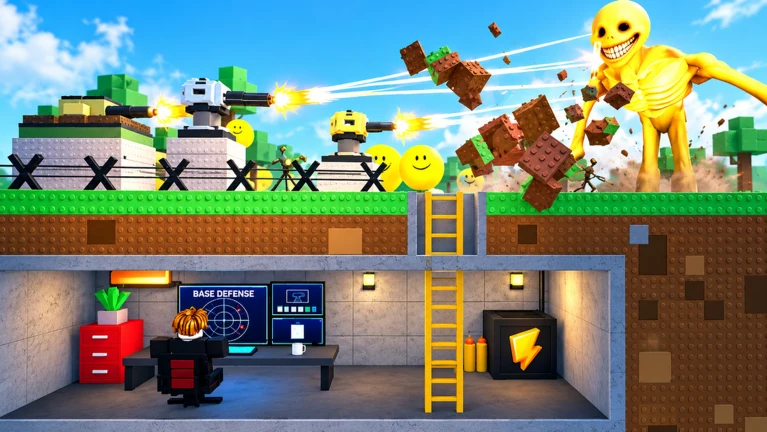
- Bunker vs Verity is a 6-player Roblox survival experience where Verities attack player-built bunkers in escalating waves.
- Playing the Verity side means understanding breach timing, weak-point targeting, and how defenders allocate repairs.
- Best approach: pressure the most damaged wall section instead of spreading attacks across the whole structure.
- Critical tip: defender coin reserves dry up in late waves, so sustained pressure on one lane forces repair mistakes.
- Know both sides: mastering bunker defense makes your Verity play sharper, because you know exactly what defenders fear.
How the Verity Role Works in Bunker vs Verity
In Bunker vs Verity, the core loop is asymmetric: up to six players build, fund, and defend a bunker while Verities — the hostile creatures of the experience — apply escalating pressure across enemy waves. If you are approaching the game from the "Verity mod" angle, your goal is to think like the attacking force: understanding where bunkers are weakest, when defenders are broke, and which lanes they forgot to cover.
The Verity side of the matchup is defined by three pressures that all attackers in this genre exploit:
| Pressure Type | What It Targets | When It Peaks |
|---|---|---|
| Structural pressure | Walls, entrances, reinforced sections | Middle and late waves |
| Economic pressure | Defender coin reserves and repair budgets | Late waves |
| Attention pressure | Repair task division and turret coverage gaps | Between waves and high-intensity waves |
Understanding these three axes turns "run at the bunker" into an actual strategy. Defenders win by converting coins into sustained damage and durability; attackers win by making defenders spend coins faster than they earn them.
Every bunker, no matter how elaborate, has approach lanes. Compact solo bunkers usually have one; cooperative crossfire bunkers have two or more. As the attacking mindset, always identify which lane has the worst turret coverage — that is your breach point.
Reading Bunker Builds Before You Attack
The strongest defensive layouts in Bunker vs Verity fall into recognizable archetypes. Learning to read them quickly tells you where the weaknesses live.
Compact Solo Bunker
- One controlled entrance, short wall lines
- Best early-game coverage
- Weakness: limited space means bad firing angles are extremely costly
Cooperative Crossfire Bunker
- Two overlapping firing directions
- Split repair and building duties
- Weakness: crowded interiors reduce visibility and movement
Long-Wave Reinforced Bunker
- Primary line plus fallback position
- Built for extended survival
- Weakness: larger footprint leaves unfinished sections exposed early
A fourth archetype, the hidden-defense layout, protects turrets behind strong structural sections. Its weakness is blind spots: overusing cover reduces the effective range of the defense line, which creates approach windows the Verity side can exploit.
The table below summarizes how each build should be attacked:
| Bunker Build | Primary Weakness | Best Attack Angle | Risk Level |
|---|---|---|---|
| Compact Solo | Blocked firing angles | Rear or side wall with no turret coverage | Low |
| Cooperative Crossfire | Interior crowding | The lane with fewer overlapping arcs | Medium |
| Long-Wave Reinforced | Unfinished sections | Recently built or unupgraded walls | High |
| Hidden-Defense | Blind spots from over-cover | Gaps where turret range is cut off | Medium |
Never approach through the lane where two or more turrets have overlapping fields of fire. Defenders deliberately build crossfire bunkers to punish exactly that mistake. Route through the coverage gap instead, even if it takes longer.
Step-by-Step: Attacking a Bunker Like a Verity
This step flow mirrors the decision process the Verity force follows across a match. Use it whether you are studying the enemy AI patterns or thinking through the matchup from the attacking perspective.
Scout the approach lanes
Before committing, identify every entrance, wall section, and turret position. Count how many firing arcs cover each lane. The lane with the fewest is your candidate breach point.
Find the unfinished or damaged section
Reinforced bunkers are built over time, which means some walls are newer, thinner, or lower-tier than others. Damaged sections from earlier waves are even better targets.
Concentrate pressure on one lane
Spread attacks across four walls and every section gets repaired. Focus sustained pressure on a single lane and the defenders must choose between repairing that wall, upgrading turrets, or losing the breach.
Force the coin decision
Late waves are when defenders run low on reserves. If they empty their wallet on repairs, they cannot add turrets. If they save for turrets, the wall falls. Either outcome favors the attacker.
Exploit the breach fast
Once a section fails, defenders scramble to reposition. That transition window — when firing angles are blocked and players are moving — is the highest-value attack moment in the entire match.
Defender guides consistently recommend "overlapping coverage instead of isolated placements." That advice exists precisely because concentrated lane pressure beats scattered attacks. If the defense meta is built around answering your pressure, your pressure is working.
Wave-by-Wave Matchup Table
The Verity side grows stronger as waves progress, but so do defenses. Here is how the matchup shifts across the phases of a run, based on the standard wave structure of the game:
| Wave Phase | Defender Priority | Attacker Opportunity | Best Verity Play |
|---|---|---|---|
| Early waves | Close exposed entrances, first turret on main approach | Bunkers are incomplete; coverage is thin | Probe multiple lanes to map turret positions |
| Middle waves | Upgrade frequently attacked wall sections | Repair budgets stretch thin | Commit to the most-damaged lane with sustained pressure |
| Late waves | Structural survival, reinforce weakest sections | Defender reserves are lowest | Full concentration on one breach point; punish repair delays |
| Between waves | Inspect damage, assign responsibilities | Preparation windows expose intent | Note which sections they repair — un-repaired walls are targets |
Two details from this table deserve emphasis. First, defenders are told to "enter difficult waves with a reserve rather than relying on income earned during the attack" — meaning late-wave defenders who spent early are the most vulnerable. Second, between-wave inspection reveals their priorities: whatever they do not repair is the section they can least afford to fix.
Coins are most valuable when converted into survival power. The attacker's job is to make every coin convert inefficiently — forced repairs on low-value walls, turret replacements in panic positions, and duplicate purchases from poor communication.
Co-op Defense Patterns and How to Break Them
Team roles in Bunker vs Verity follow predictable patterns, and each pattern has an exploitable gap:
| Team Setup | Roles | Exploitable Gap |
|---|---|---|
| Two players | Builder and Defender | One player doing both repairs and combat during pressure spikes |
| Three players | Builder, Gunner, Scout | Scout must call threats early; late callouts mean unreinforced sections |
| Four or more | Dedicated defense team with resource coordinator | Coordination overhead — duplicate spending and unattended lanes |
| Any size | Wave Coordinator | Plan is made between waves; attack during transitions |
The most reliable gap in any co-op setup is the transition. Role-based defenses depend on players being in position. A breach that opens while the builder is upgrading or the gunner is repositioning creates a window where nobody is effectively defending that lane.
The same principle cuts both ways. Defense guides warn players not to chase enemies away from the defensive zone because "chasing enemies away from the defensive zone can create openings." As the attacker, your best asset is a defender who leaves their post — bait movement, then hit the empty lane.
Verity-Side Attack Checklist:
- Identify all approach lanes and count turret coverage on each
- Locate the unfinished, damaged, or un-repaired wall section
- Commit pressure to a single lane instead of spreading attacks
- Track defender coin behavior — panic spending signals success
- Exploit breaches during repair and reposition transitions
Game Details and FAQ
Bunker vs Verity is developed by Beyondd Games and runs on Roblox as a survival / escape / PvE experience with a six-player server size. Since its creation in late September 2026, it has drawn over a million visits, with concurrent player counts regularly in the thousands. Because the game updates frequently — the most recent recorded update came in early October 2026 — always check the official Roblox game page for current mechanics before applying any strategy.
Some players search for a "Verity mod" or playable Verity mode. There is no confirmed official playable-Verity mode documented in current public game information; this guide covers the attacking-side mindset within the standard wave format. Treat any downloadable "mods" or third-party scripts with caution — they are not official content and may violate Roblox terms.
Q: Can you actually play as a Verity in Bunker vs Verity?
Based on currently available public game information, Bunker vs Verity is a defensive survival experience where players build bunkers against Verity waves. No official playable-Verity mode has been confirmed. This guide teaches the attacker-side mindset so defenders can anticipate Verity behavior — and so content creators exploring the matchup understand both sides.
Q: What is the best way to break a bunker in Bunker vs Verity?
Concentrate sustained pressure on a single lane, ideally a section that is unfinished, damaged, or not repaired between waves. Spreading attacks across the whole structure lets defenders repair everything; focused pressure forces them into bad coin decisions.
Q: When are defenders weakest in Bunker vs Verity?
Late waves, when coin reserves run low, and during transitions — when a builder is upgrading, a gunner is repositioning, or a breach has just opened. Defenders who chase attackers away from their posts also create exploitable gaps.
Q: Does Bunker vs Verity have codes?
There is no confirmed set of publicly active codes at the time of writing. If codes are added, they would appear through the in-game redemption interface or official Beyondd Games channels. Avoid third-party sites claiming to offer codes, as these are frequently unreliable.