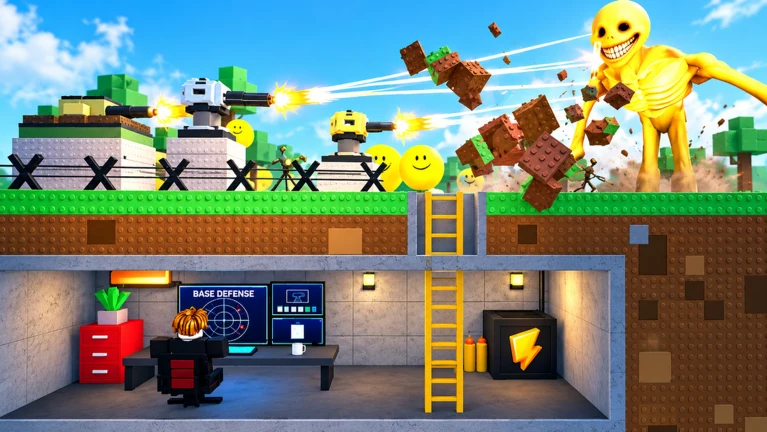
- Bunker vs Verity mutant battle is the core defensive loop: protect your bunker from escalating Verity waves.
- Wave phases matter: priorities change across early, middle, and late waves.
- Reserve coins: keep a repair fund instead of spending everything before nightfall.
- Turret placement beats turret count: overlapping firing lanes outperform scattered defenses.
- Co-op roles win runs: divide building, gunning, and scouting responsibilities.
How the Mutant Battle Loop Works
In Bunker vs Verity, every match follows a survival rhythm: build by day, defend by night. Verities — the mutants pressuring your position — arrive in waves that grow stronger over time. Your job is to construct a bunker, place defenses, earn coins, and hold the line as the pressure climbs. The developer, Beyondd Games, designed the experience around defensive survival with up to six players per server, so teamwork and preparation decide most outcomes.
The battle is less about raw combat skill and more about resource discipline. A team that over-builds early runs out of coins for repairs; a team that under-builds gets breached before the middle waves. Success sits between those two failure modes.
Survival in Bunker vs Verity depends on converting coins into reliable defense power before pressure peaks — not during it. Preparation windows between waves are your real battlefield.
Wave-by-Wave Battle Strategy
Enemy waves escalate in number and durability, so your spending plan must evolve with them. The table below breaks down what to prioritize in each phase of a run.
| Phase | Wall Priority | Turret Priority | Coin Preparation | Under Pressure |
|---|---|---|---|---|
| Early waves | Close exposed entrances, build core structure | One turret covering the main approach | Keep reserve after first purchases | Kill enemies reaching the bunker, skip expansion |
| Middle waves | Upgrade sections that take repeated hits | Add coverage only when a lane slips | Save for repairs plus one upgrade | One player repairs while another fights |
| Late waves | Reinforce weakest sections, structural survival | Upgrade effective positions, keep overlap | Enter hard waves with a reserve | Repair immediately, focus dangerous targets first |
| Between waves | Inspect damage, predict next breach | Check firing angles and gaps | Split coins between repairs and next upgrade | Assign responsibilities before the wave |
Early Game: Establish
- Small, closed structure beats a large unfinished one
- One dependable turret on the main lane
- Never spend the full starting budget
Late Game: Endure
- Overlapping fire lanes over scattered turrets
- Emergency repair fund at all times
- Concentrate fire on the most dangerous mutants
Chasing Verities away from your defensive zone is one of the most frequent ways to lose a run. Leaving the bunker creates openings — hold your position and let the defenses work.
Turret Roles in Mutant Fights
Turret value shifts depending on the threat pattern. Instead of chasing a single "best" turret, build a defensive network where each placement covers a specific job.
| Tier | Role | Strengths | Best Use |
|---|---|---|---|
| S | Balanced core defense | Reliable damage, good range, repeatable value | Main entrance coverage, first specialization |
| A | Single-target damage | Melts durable individual mutants | Late waves with dangerous lone threats |
| A | Crowd-control defense | Slows groups, buys repair time | Waves hitting the bunker simultaneously |
| B | Fast-attack early defense | Quick response, cheap initial coverage | Opening phase before income stabilizes |
| C | Narrow-specialty defense | Situational, placement-dependent | Secondary lanes in planned layouts |
Two turrets with overlapping fields of fire almost always outperform two turrets watching separate, rarely-used lanes. Coverage density beats coverage area.
Step-by-Step: Your First Successful Defense
Choose a defensible location
Pick a spot with clear sightlines and room to move, repair, and expand later. Avoid positions where walls or teammates block firing paths.
Build the bunker structure
Place main walls and the entrance first. Keep the interior compact and easy to reinforce — skip decorative construction early.
Place initial defenses
Position your first turret to cover the entrance approach. Prioritize overlapping coverage over isolated placements.
Earn and preserve coins
Use safe windows to earn coins, but never empty your wallet before nightfall. A reserve is worth more than a small early upgrade.
Prepare for the night
Do a final inspection: check firing angles, clear movement paths, and get the team inside the defensive zone before the attack.
Respond to the mutants
Watch the approach, repair damaged sections, and shift attention to the weakest side instead of abandoning the defense.
If you finish the first three waves with intact walls and a coin reserve, your opening was successful — most failed runs collapse from an early overspend.
Co-op Roles and Economy Discipline
Mutant battles reward coordination. Teams that divide responsibilities consistently outperform groups where everyone builds independently.
| Team Size | Recommended Roles | Key Coordination |
|---|---|---|
| Two players | Builder and Defender | Communicate before any purchase |
| Three players | Builder, Gunner, Scout | Scout calls threats early for reinforcement |
| Four or more | Dedicated defense team | Resource coordinator prevents duplicate spending |
Pre-Wave Checklist:
- Bunker fully repaired from the last wave
- Turrets have clear, unblocked firing angles
- Coin reserve set aside for emergency repairs
- Each teammate knows their lane or role
- Weakest wall section identified and reinforced
Improve the defense that is directly limiting survival first. Adding more turrets when the existing ones are blocked or poorly placed is the most common waste in Bunker vs Verity.
FAQ
Q: What is the Bunker vs Verity mutant battle about?
It is the game's core defensive loop: you build a bunker, place turrets, and hold off escalating waves of mutants called Verities. Survival depends on preparation between waves rather than combat during them.
Q: Should I spend all my coins before the first night?
No. Keep a reserve. A repair fund is usually more valuable than a small early upgrade, because one breached wall during the first waves can end a run before your income grows.
Q: What matters more: more turrets or better placement?
Better placement. Overlapping firing lanes covering the main approach consistently outperform a larger number of scattered turrets. Upgrade effective positions before adding new ones.
Q: How do co-op teams win longer waves?
By dividing roles: one player builds and repairs, others operate the primary firing lanes, and a flexible player handles emergencies. A resource coordinator should announce major purchases to avoid duplication.