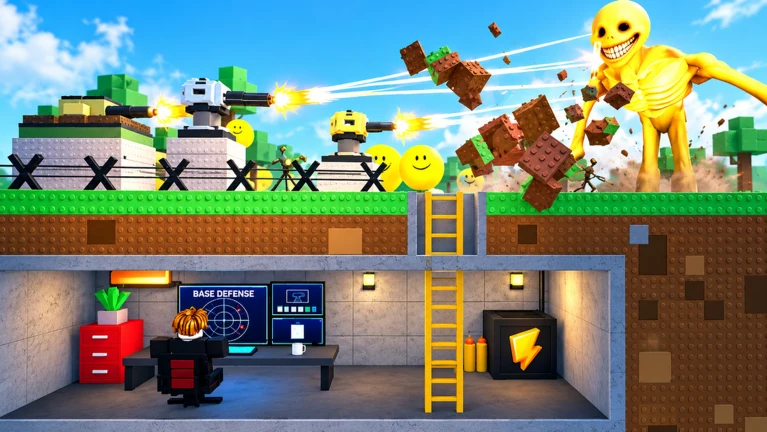
- Bunker vs Verity JJ and Mikey bunker play centers on duo teamwork, fast builds, and strong entrance coverage.
- Co-op roles matter: one player builds and repairs while the other controls the main firing lane.
- Coin discipline wins runs: keep a repair reserve instead of spending everything before nightfall.
- Turret overlap beats quantity: two overlapping arcs outperform scattered single placements.
- Night prep is the make-or-break moment: inspect walls, firing angles, and paths before Verities arrive.
Why the JJ and Mikey Bunker Style Is Popular
The Bunker vs Verity JJ and Mikey bunker approach has become one of the most searched playstyles for this Roblox survival experience. Popular duo content in this style highlights a simple but effective formula: two players split responsibilities, build a compact bunker fast, and hold the entrance together against escalating Verity waves. The good news is that you do not need to copy a specific creator run to make it work — the underlying strategy follows core game principles that any pair of players can execute.
Bunker vs Verity, developed by Beyondd Games, is a defensive survival experience where you build a bunker, place turrets, earn coins, and survive night attacks. Each server holds up to six players, so duo runs like the JJ and Mikey bunker format fit naturally into the game's design.
Duo runs succeed through role clarity rather than raw skill. When one player owns construction and the other owns damage output, duplicate spending drops and breaches get repaired faster than in uncoordinated lobbies.
| Element | Solo Run | JJ and Mikey Style Duo |
|---|---|---|
| Build speed | Slower, phased | Fast, parallel construction |
| Coin usage | One wallet, one priority | Split plan, less duplication |
| Repair response | Pause firing to repair | One repairs while one holds |
| Turret coverage | Often single arc | Overlapping dual arcs |
| Weakness | Overwhelm at entrances | Poor communication |
Best Bunker Layouts for Duo Play
Not every layout suits a two-player run. The JJ and Mikey bunker style works best with designs that give both players clear jobs and clear firing lanes.
Compact Duo Core
- Small central room, one controlled entrance
- Short wall lines reduce repair cost
- Both players cover the same approach
- Best for early waves and low budgets
Crossfire Layout
- Two overlapping firing directions
- Entrance caught in a kill zone
- One player per lane
- Best when waves split into groups
Reinforced Fallback
- Primary line plus interior backup
- Second wall layer behind the first
- Room to retreat and repair safely
- Best for long, high-pressure runs
Whichever layout you pick, apply these placement rules:
- Protect the entrance first — it is where nearly all pressure lands.
- Keep interior paths open so repairs never require tearing down walls.
- Avoid building so tightly that teammates or structures block turret arcs.
- Add a fallback position before late waves, not during them.
Players often expand outward before the first defense line is finished. Unfinished sections are the most common breach point during early Verity attacks. Finish, then expand.
Step-by-Step: Running the Duo Bunker
Follow this sequence to replicate the high-energy duo runs popularized in JJ and Mikey style Bunker vs Verity content. Each step assumes a two-player team with a shared coin plan.
Pick a Defensible Spot
Choose terrain that gives your turrets long sightlines toward the main approach, with room behind the bunker for a fallback. Agree on the spot before spending anything.
Split the Build
One player frames the walls and entrance while the other preps the interior and first turret position. Parallel building is the biggest duo advantage — use it.
Place First Turrets for Overlap
Position your earliest turret to cover the main lane. The second turret should cross its arc with the first instead of watching a dead angle. Overlapping coverage multiplies effective damage.
Bank Coins Before Nightfall
Do not empty the wallet on upgrades before the first attack. A repair reserve often saves a run that a small early upgrade cannot.
Run the Night Check
Before Verities arrive, walk the perimeter: blocked arcs, wall gaps, blocked movement paths, and unstuffed turrets are the four classic failure causes.
Hold and Rotate
During the wave, one player fires while the other repairs the weakest section. Rotate attention toward whichever side is taking damage instead of chasing enemies away from the bunker.
Use short callouts — lane, problem, urgency. "East wall, breach, now" is faster and more useful than a full sentence mid-wave.
Turret Roles and Wave Priorities
Turret value in Bunker vs Verity changes with the wave phase. The tier logic below reflects how each defensive role performs across a run rather than a flat ranking.
| Role | Best Phase | Strengths | Watch Out For |
|---|---|---|---|
| Balanced Core Defense | All phases | Reliable damage, solid range, cost-efficient | Rarely the best at any one job |
| Single-Target Damage | Mid to late | Melts durable Verities, scales with support | Needs clear sightlines |
| Crowd-Control Defense | Mid waves | Buys repair time, strong at chokepoints | Low direct damage alone |
| Fast-Attack Early Defense | Opening | Cheap, quick response, easy coverage | Falls off as durability rises |
| Narrow-Specialty Defense | Situational | Excellent in the right lane | Poor placement wastes it entirely |
Wave-phase spending plan:
| Phase | Wall Priority | Turret Priority | Coin Rule |
|---|---|---|---|
| Early waves | Close exposed entrances, skip upgrades | One core turret on main lane | Hold a reserve after first buys |
| Middle waves | Reinforce repeatedly-hit sections | Add coverage only where lanes slip | Save for one repair + one upgrade |
| Late waves | Structural survival first | Upgrade effective positions | Enter hard waves with a buffer |
| Between waves | Inspect damage, find next breach point | Check arcs and coverage gaps | Split coins: repairs now, upgrades next |
Upgrade the turret or wall that is directly limiting your survival first. Expanding coverage before fixing the active weak point is the most common way strong runs end.
Duo Run Checklist
Before and during every run, work through this list as a pair. It covers the milestones that separate clean duo survivals from collapsed bases.
Duo Survival Checklist:
- Agree on roles before the first coin is spent
- Finish the entrance and first wall line before expanding
- Confirm two overlapping turret arcs on the main lane
- Hold a coin reserve entering every night phase
- Walk the perimeter night check before each wave
- Assign repair and firing roles before pressure peaks
In three or four player servers, keep the same structure: one builder, one or two gunners on fixed lanes, and one flexible player for emergencies. Adding players without adding roles usually creates gaps, not coverage.
FAQ
Q: What is the JJ and Mikey bunker style in Bunker vs Verity?
It refers to a popular two-player approach where one player handles bunker construction and repairs while the other controls the main firing lane. The style emphasizes fast parallel building, overlapping turret coverage, and a shared coin plan rather than solo carry play.
Q: Can I run a duo bunker strategy solo in Bunker vs Verity?
Yes, but expect trade-offs. Use a compact core layout with one controlled entrance, prioritize a single reliable turret arc, and keep a larger repair reserve since you must pause firing to fix walls yourself.
Q: Should I spend all my coins before the first night?
No. Keep a reserve. A repair budget during the first Verity attack is usually more valuable than one extra early upgrade, because breached walls end runs faster than slightly weaker turrets.
Q: Where can I play Bunker vs Verity?
The game runs on Roblox and is developed by Beyondd Games. Use the official Roblox listing to access the experience and review current update information before starting a session.
This is an independent fan-made guide website and is not affiliated with Beyondd Games or Roblox.