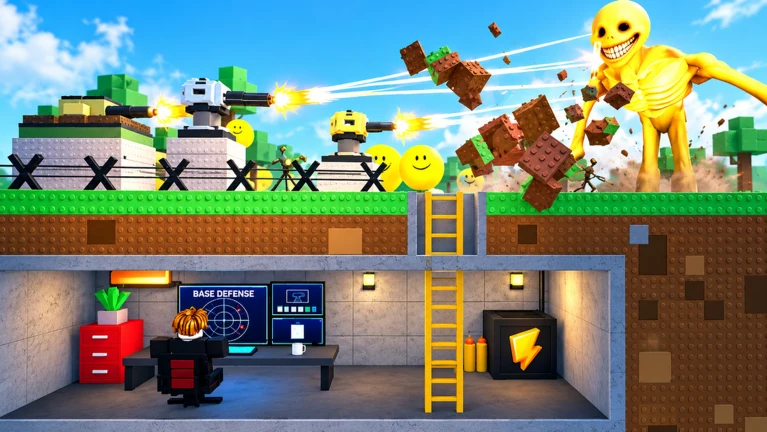
- Bunker vs Verity survival guide: This Roblox defense experience rewards preparation over fast spending.
- Core loop: Build a bunker, place turrets, earn coins, and repair before each Verity wave.
- Golden rule: Keep a coin reserve for emergency repairs instead of spending everything before nightfall.
- Wave strategy: Reinforce the weakest lane between waves, never during a breach.
- Co-op tip: Assign clear roles early — duplicated purchases waste more runs than enemy damage.
Bunker vs Verity Survival Fundamentals
Bunker vs Verity, developed by Beyondd Games, is a defensive survival experience on Roblox where up to six players per server build a bunker, manage coins, and hold out against increasingly dangerous waves of Verities. Survival is not about having the biggest base — it is about having a stable one. A compact bunker with clear firing lanes outperforms a sprawling structure with blocked turrets and exposed entrances.
Every successful run follows the same rhythm: prepare during the day, defend at night, then inspect and repair between waves. The table below breaks down what matters most in each part of that cycle.
| Phase | Main Goal | Highest-Impact Action |
|---|---|---|
| Day preparation | Finish core structure | Close exposed entrances, verify turret firing angles |
| Night defense | Hold the line | Focus fire on enemies reaching the bunker, repair weak walls |
| Between waves | Recover and upgrade | Inspect damage, reinforce the likeliest breach point |
| Late game | Sustain output | Upgrade proven turrets, maintain overlapping coverage |
Do not spend your entire coin balance before the first night. A reserve for emergency repairs is usually worth more than one extra early upgrade — a single breached wall can end a run that a small repair fund would have saved.
Best Bunker Builds for Every Team Size
The strongest layout depends on player count, resources, and expected wave length. Whichever build you choose, it must protect the entrance, preserve clear firing lanes, provide a safe movement route, and include a fallback position.
Compact Solo Bunker
- Best for: Solo players, early survival
- Small central room with a controlled entrance
- Short wall lines, defenses on the main approach
- Weakness: Blocked firing angles are very costly
Cooperative Crossfire Bunker
- Best for: Two or more players
- Central area with two overlapping firing directions
- Teammates cover separate approach lanes
- Weakness: Crowded interiors reduce visibility
Long-Wave Reinforced Bunker
- Best for: Extended survival, later waves
- Primary line, protected interior route, secondary fallback
- Resources reserved for repeated repairs
- Weakness: Unfinished sections are vulnerable early
| Build | Entrance Control | Repair Access | Cost Efficiency | Late-Wave Scaling |
|---|---|---|---|---|
| Compact Solo | ★★★★★ | ★★★☆☆ | ★★★★★ | ★★☆☆☆ |
| Crossfire Co-op | ★★★★☆ | ★★★★☆ | ★★★★☆ | ★★★★☆ |
| Reinforced Long-Wave | ★★★★☆ | ★★★★★ | ★★★☆☆ | ★★★★★ |
| Hidden-Defense Layout | ★★★☆☆ | ★★★☆☆ | ★★★☆☆ | ★★★★☆ |
Prioritize overlapping turret coverage over isolated placements. Two turrets covering the same approach lane almost always beat two turrets watching separate, low-traffic directions.
Step-by-Step: Your First Successful Night
New players fail for predictable reasons: poor location choice, overspending, and blocked firing paths. Follow this sequence to reach the later waves consistently.
Choose a defensible location
Pick a position with clear sightlines for your defenses and enough room for movement, repairs, and later expansion. Avoid building so tightly that walls or teammates block firing paths.
Build the bunker structure
Place main walls and the entrance first, then a compact interior that can be reinforced later. Skip decorative construction during the opening phase.
Place your first defenses
Position turrets where they cover the approach to the entrance and the most likely attack lane. Overlap fields of fire instead of spreading everything thin.
Earn and preserve coins
Use safe windows to earn coins while keeping enough funds for repairs, extra walls, and emergency defenses. Never empty your wallet before nightfall.
Run a final pre-night inspection
Check firing angles, clear movement paths, and confirm the team is inside the defensive zone. A quick sweep reveals blocked turrets and missing wall sections.
Respond to Verities without abandoning the base
Watch the approach, repair damaged sections, and shift attention to the weakest side of the bunker. Chasing enemies away from your defense zone creates openings.
If you finish the first night with repaired walls, at least one intact turret, and coins still in reserve, your opening was successful — regardless of how many enemies slipped through.
Coins and Upgrade Priorities
Coins are only valuable once converted into survival power. The biggest economy mistakes are buying low-impact positions before confirming which lane actually needs coverage, and stacking turrets when existing ones are blocked or misplaced.
| Stage | Upgrade Priority | Resource Rule | Common Waste |
|---|---|---|---|
| Opening | Essential construction, then one strong defensive position | Never spend the full starting budget before the first defense works | Building multiple low-impact positions early |
| Development | Improve the wall or turret directly limiting survival | Keep a repair reserve at all times | Adding turrets when existing ones are blocked |
| Late game | Sustained damage, structural durability, danger-lane coverage | Enter hard waves with a reserve, not mid-wave income | Cosmetic upgrades while the core is vulnerable |
| Team play | Coordinate who buys what | Stabilize base, maintain damage, then add coverage | Duplicate purchases from poor communication |
Narrow-specialty defenses can shine in one specific lane but drop sharply in value when the wave pattern changes. Build one balanced core defense before adding situational options.
Wave-by-Wave Defense Strategy
Enemy waves grow harder as the match progresses, so resources must be spent before a crisis begins. Use the early game to establish a reliable bunker, the middle game to reinforce slipping lanes, and the late game to keep damage output alive while repairing under pressure.
| Wave Phase | Wall Priority | Turret Priority | High-Pressure Action |
|---|---|---|---|
| Early waves | Close the most exposed entrances first | One turret covering the main approach | Kill enemies that reach the bunker, do not expand |
| Middle waves | Upgrade sections enemies repeatedly attack | Add coverage only when a lane consistently slips | One player repairs while another fights |
| Late waves | Reinforce weakest sections, skip cosmetics | Upgrade proven positions, keep overlap | Protect the core, focus the most dangerous targets |
| Between waves | Inspect damage, predict the next breach | Check firing angles and coverage gaps | Assign responsibilities before the next wave |
For co-op teams, clear roles prevent both duplicate spending and unattended breaches:
| Team Size | Recommended Roles | Key Coordination Tip |
|---|---|---|
| Two players | Builder + Defender | Agree on purchases before spending coins |
| Three players | Builder + Gunner + Scout | Scout calls threats early so the builder reinforces in time |
| Four or more | Dedicated defense team + resource coordinator | Use short callouts: lane, repair needed, urgency |
| Any size | Wave Coordinator | Make the plan during the prep window, not mid-attack |
Between-Wave Checklist:
- Repair all damaged wall sections
- Verify every turret has a clear firing angle
- Confirm the coin reserve covers one emergency repair
- Reinforce the section most likely to breach next
- Assign roles before the next wave begins
FAQ
Q: What is the best survival strategy for beginners in Bunker vs Verity?
Start with a compact bunker in a defensible spot, place one turret covering the main approach, and keep a coin reserve instead of spending everything before the first night. Survival depends on maintaining your bunker during attacks, not chasing enemies away from it.
Q: Should I upgrade walls or add more turrets first?
Upgrade whichever one is directly limiting your survival. If enemies break through walls, reinforce those sections first. If waves survive long enough to damage the bunker, your turret coverage or placement is the problem — fix blocked firing angles before buying new turrets.
Q: How many players can play together?
Bunker vs Verity servers hold up to six players. Teams perform best with divided responsibilities: at least one player handling construction and repairs, others operating the primary firing lanes, and one flexible player for emergency reinforcement.
Q: What is the most common way runs fail?
Most runs end from overspending before nightfall, blocked turret firing angles, or abandoned defense positions. Keep a repair reserve, inspect firing lanes between waves, and stay near your bunker during attacks.
Bunker vs Verity receives frequent updates from Beyondd Games. Check the official Roblox game page before a session for new content, balance changes, and mechanic adjustments that could shift the best defensive strategies.