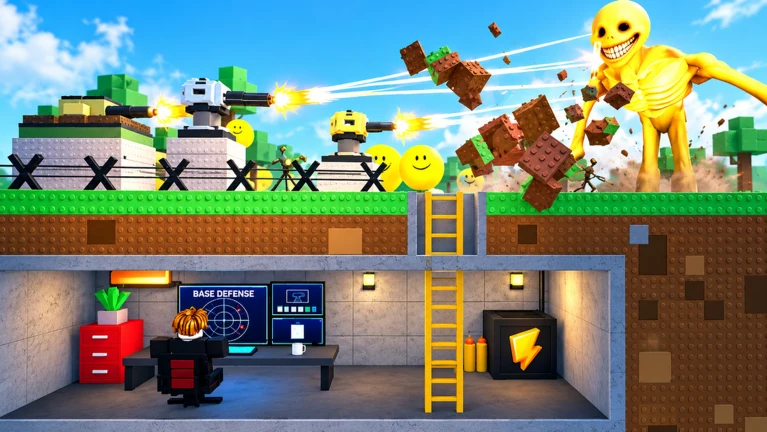
- Skybase strategy: Elevating your bunker off the ground limits how Verities can reach your base
- Placement rules: Keep firing lanes open, build a controlled entrance, and leave repair routes
- Turret coverage: Overlapping arcs matter more than raw turret count on a skybase
- Resource discipline: Always hold a coin reserve for emergency wall repairs
- Team roles: Assign one builder and one gunner minimum for stable skybase defense
Why Build a Skybase in Bunker vs Verity
A skybase in Bunker vs Verity is a defensive structure raised above the ground plane, built to control which angles Verities can use to reach your team. Instead of fighting on the attackers' terms, a skybase forces threats into a limited approach: a single elevated entrance, a supported platform, or a narrow stair path your turrets can cover.
The core value of a skybase comes from approach control. Ground bunkers can be attacked from every exposed wall section at once, splitting your repair attention. A well-built skybase concentrates pressure into one or two predictable lanes, which lets fewer defenses do more work.
Skybases are resource-intensive. If you commit too many coins to height and platforming early, you may not have funds left for turrets and repairs when the first waves arrive. Build the minimum viable structure first, then elevate.
Skybase vs Ground Bunker Comparison:
| Factor | Skybase | Ground Bunker |
|---|---|---|
| Attack angles | Few, controlled approaches | All exposed walls |
| Build cost | Higher upfront | Lower upfront |
| Repair access | Limited routes, plan carefully | Easy access from all sides |
| Turret efficiency | High, concentrated arcs | Spread across multiple lanes |
| Failure mode | Collapse of support/entrance | Progressive wall breaches |
| Best for | Co-op teams, mid/late runs | Solo and early survival |
When to choose each approach:
| Situation | Recommended Base |
|---|---|
| Solo, first waves | Compact ground bunker |
| Two players, stable income | Elevated skybase with crossfire |
| Extended waves, large reserve | Reinforced skybase with fallback layer |
| Low coin reserve | Ground bunker, upgrade later |
Skybase Layouts and Build Comparison
The strongest skybase design depends on your player count, income, and how long you expect the run to last. Every layout should protect the entrance, preserve clear firing lanes, and include a fallback position.
Compact Solo Skybase
- Small elevated platform with one controlled entrance
- Short wall lines reduce repair cost
- Single turret covering the stair path
- Weakness: blocked firing angles are very costly
Crossfire Skybase
- Two overlapping firing directions toward the approach
- Best for two or more players
- Divided repair and monitoring duties
- Weakness: crowded interiors reduce movement
Long-Wave Reinforced Skybase
- Primary line plus interior fallback behind the first layer
- Coin reserve reserved for repeated repairs
- Built for extended survival pressure
- Weakness: expensive, unfinished sections are vulnerable early
Hidden-Defense Skybase
- Turrets placed behind strong structural sections
- Openings preserved toward the approach route
- Protects valuable defenses from direct damage
- Weakness: overusing cover creates blind spots
Prioritize overlapping turret coverage over turret count. Two turrets sharing one approach lane outperform four turrets each covering separate, rarely-used angles.
Layout evaluation by wave phase:
| Layout | Early Waves | Mid Waves | Late Waves |
|---|---|---|---|
| Compact Solo | ★★★★★ | ★★★ | ★★ |
| Crossfire | ★★★ | ★★★★★ | ★★★★ |
| Reinforced | ★★ | ★★★★ | ★★★★★ |
| Hidden-Defense | ★★★ | ★★★★ | ★★★★ |
Skybase Construction Step-by-Step
Follow this sequence to get a functional skybase online before nightfall without draining your coin reserve. The order matters: structure first, defenses second, upgrades last.
Choose a defensible position
Pick a location with clear sightlines toward the likely Verity approach. Leave room for the platform footprint, repair movement, and later expansion. Avoid spots where terrain or your own walls will block turret firing paths.
Build the support structure and platform
Place supports and the platform deck first, keeping the footprint compact. A smaller skybase is cheaper to wall, cheaper to repair, and easier for turrets to cover completely.
Create one controlled entrance
Funnel all access through a single stair or doorway your turrets can watch. Multiple entrances on a skybase split your defenses and double your repair workload.
Place initial defenses on the approach
Position your first turret so its arc covers the entrance path and the main approach lane. Add a second only when a lane is consistently slipping through.
Keep a coin reserve
Do not spend your full balance before nightfall. A reserve for emergency wall repairs is usually more valuable than one extra early upgrade.
Do a pre-wave inspection
Before each wave, check firing angles, blocked turrets, exposed platform edges, and missing wall sections. Fix weak points during the preparation window, not during the attack.
A 20-second check between waves routinely reveals blocked turret arcs, exposed entrances, and missing platform sections — the three most common causes of sudden skybase failures.
Wave Defense and Economy for Skybases
Enemy waves grow stronger as the match progresses, so your spending should happen before a crisis, not during it. Skybases punish panic purchases especially hard, because structural failures can cut off repair access entirely.
Wave-phase priorities for skybases:
| Phase | Structure Priority | Turret Priority | Coin Rule |
|---|---|---|---|
| Early waves | Close exposed platform edges before upgrades | One turret on the main approach | Hold a reserve after first builds |
| Middle waves | Reinforce the most-attacked section first | Add coverage only when a lane slips | Save for repair + one upgrade |
| Late waves | Structural survival over cosmetics | Upgrade effective positions, keep overlap | Enter hard waves with a reserve |
| Between waves | Inspect for the next breach point | Check arcs and coverage gaps | Split coins between repairs and upgrades |
Common skybase mistakes to avoid:
| Mistake | Consequence | Fix |
|---|---|---|
| Building too tall too early | No coins left for turrets | Minimum viable height first |
| Multiple entrances | Split, thin defenses | One controlled funnel |
| Turrets behind full cover | Blocked firing arcs | Preserve open sightlines |
| Spending full reserve pre-wave | No emergency repairs | Always hold repair funds |
| Duplicate team purchases | Wasted coins | Assign one resource coordinator |
When a wave is breaking through, concentrate fire on the most dangerous target first and repair immediately after damage spikes. Chasing Verities away from your defensive zone creates openings at the platform entrance.
Skybase Readiness Checklist
Run through this checklist before committing to a skybase strategy and again before each major wave.
Skybase Readiness:
- Defensible position chosen with clear sightlines
- Platform and one controlled entrance completed
- Initial turret covering the main approach lane
- Coin reserve held for emergency repairs
- Pre-wave inspection of arcs, walls, and platform edges
In teams, assign one player to construction and repairs, one to turret operation, and one flexible responder. Use short, specific callouts: affected lane, needed repair, urgency level.
FAQ
Q: Is a skybase better than a ground bunker in Bunker vs Verity?
Skybases concentrate enemy pressure into fewer approach lanes, which improves turret efficiency. However, they cost more upfront and punish poor planning. Solo players and early waves are usually better served by a compact ground bunker first.
Q: When should I start elevating my bunker?
Start elevating once you have stable wave income and a coin reserve. Committing to height before your first turret is functional often leaves you unable to afford defenses when the first waves arrive.
Q: How many entrances should a skybase have?
One controlled entrance. Multiple access points split your turret coverage and double your repair workload, which is the most common cause of skybase collapses under pressure.
Q: What is the biggest skybase mistake in co-op play?
Duplicate spending. When teammates independently build the same defenses, coins are wasted and critical lanes go uncovered. Designate one player to coordinate major purchases.